Bücher Kostenlos A Short History of Financial Euphoria (Penguin business), by John Kenneth Galbraith
Abgeschlossen mit Ihrer Freizeit sowie kein Konzept hat, wie zu tun? Beziehen Sie die A Short History Of Financial Euphoria (Penguin Business), By John Kenneth Galbraith und auch nehmen Sie es als Ihre Analyse Buch. Warum sollte lesen werden? Einige Menschen werden denken sicherlich, dass dies eine sehr faul und auch uninteressant Aufgabe zu tun. Darüber hinaus zahlreiche zusätzliche Zeit denken häufig, dass sie frei sind. Das ist nicht die Zeit für das Lernen. Nun, liest gerade für Ihre beim Lernen oder Lernen etwas? das ist auf jeden Fall nicht.
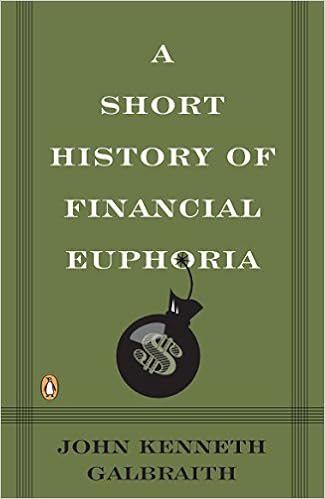
A Short History of Financial Euphoria (Penguin business), by John Kenneth Galbraith

Bücher Kostenlos A Short History of Financial Euphoria (Penguin business), by John Kenneth Galbraith
Kommen Sie mit uns die außergewöhnliche Lesung Veröffentlichung zu entdecken aus der ganzen Welt! Wenn Sie so herausfordernd fühlen mehrere Bücher aus verschiedenen anderen Nationen zu entdecken, wird es sicherlich nicht unterschreiten. In dieser Website haben wir Milliarden Titel von Führungen aus dieser Nation und auch im Ausland. Und zu erinnern, werden Sie nie dieses Buches hinauslaufen, wie es in der Buchhandlung. Warum? Wir bieten die weichen Dokumente dieser Bücher von allen Besuchern bequem zu bekommen.
Currently, your time is to produce the various atmosphere of your every day life. You could not feel that it will certainly be so silent to know that this publication is absolutely yours. And also just how you can wait on guide to read, you could simply locate the web link that has been given in this website. This site will provide you all soft duplicate fie of guide that can be so simple to find out about. Associated with this condition, you could really realize that the book is linked constantly with the life and future.
Also you have guide to check out only; it will certainly not make you really feel that your time is actually limited. It is not just about the moment that could make you really feel so wanted to sign up with guide. When you have picked guide to review, you could save the time, even few time to always check out. When you think that the time is not just for obtaining the book, you can take it right here. This is why we concern you to use the very easy methods getting the book.
When his is the time for you to always make manage the function of guide, you could make bargain that guide is really recommended for you to obtain the best suggestion. This is not just ideal suggestions to gain the life but also to undertake the life. The lifestyle is in some cases conformed to the instance of excellences, but it will certainly be such point to do. And also now, the book is once again advised here to check out.
Synopsis
With all the financial know-how and experience of the wizards on Wall Street and elsewhere, how is it that the market still goes boom and bust? How can people be so willing to get caught up in the mania of speculation when history tells us that a collapse is almost sure to follow? In this primer, the renowned economist John Kenneth Galbraith reviews the major speculative episodes of the last three centuries - from the 17th century tulip craze to the calamitous junk-bond follies of the 1980s. His insights provide important lessons on speculative economics, and demonstrate conclusively that money and intelligence are not necessarily linked.
Über den Autor und weitere Mitwirkende
John Kenneth Galbraith was born in 1908 in Ontario, Canada. He earned a PhD at the University of California in 1934 and later took a fellowship at Cambridge, where he first encountered Keynesian economics. At different points in his life he taught at both Harvard and Princeton, and wrote more than forty books on an array of economic topics. During World War II he served as deputy head of the Office of Price Administration, charged with preventing inflation from crippling the war efforts, and also served as the US Ambassador to India during the Kennedy administration. He passed away in 2006.
Produktinformation
Taschenbuch: 128 Seiten
Verlag: Penguin Books; Auflage: Reprint (1. Juli 1994)
Sprache: Englisch
ISBN-10: 0140238565
ISBN-13: 978-0140238563
Vom Hersteller empfohlenes Alter: Ab 18 Jahren
Größe und/oder Gewicht:
12,8 x 0,9 x 19,6 cm
Durchschnittliche Kundenbewertung:
3.1 von 5 Sternen
5 Kundenrezensionen
Amazon Bestseller-Rang:
Nr. 89.131 in Fremdsprachige Bücher (Siehe Top 100 in Fremdsprachige Bücher)
Galbraith is one of my all-time favorite authors. It's not only his very elegant prose (before reading Galbraith, I didn't know that books about economics can be fun and even hilarious.) Galbraith, himself a Harvard Professor, is able to explain economic problems and elucidate technical dicussions - perhaps "to teach about economics" would be a more suitable expression - even to non-economists like me.This book dwells on the subject of speculation and the economic crises it causes: what originates speculation, some examples (the classic tulip case in the Netherlands in the 17th century, the Banque Royale in the 18th century, the South Sea Company in the 18th century, American examples in the 18th century, the 1929 crash, the 1987 crash), what can and what shouldn't be done against speculation. Needless to say, it is a topic that recurrently becomes important (e.g. 1987, the 1997 Asian crisis, the 2008-2009 crisis).This book is closely related to the same author's "The Great Crash 1929". But whereas the former is a rather brief study of speculation in general, the latter deals specifically with the 1929 crisis. On the one hand, if you want an introduction to the subject, "A Short History of Financial Euphoria" might be the best choice, but if you want an in depth analysis, go for "The Great Crash 1929"; on the other hand, these are complimentary books so reading both is also a good idea. Yet if I had to chose between both books, I would recommend "The Great Crash 1929".
I would not pay again 9 euros for some basic stuff about financial euphoria in the world, when i can find this basic info online.
The book reads quickly and easily; but still manages to remain quite informative.The book covers a number of periods in which rampant financial speculation was present. The end lessons: "It's not different this time" and "History is bound to repeat itself"
Reading about the history of speculation is a way to broaden one's critical views of investing. Galbraith presents the material in an entertaining way and doesn't oversell the important points he makes about mass psychology and market reform. His self-deprecatory moments are very engaging indeed. I would go so far as to suggest that this book should be required reading for any investor.
A short, concise and powerful little book. What you would expect from Galbraith. On the short list of people who can write about finance and keep it entertaining.
A Short History of Financial Euphoria (Penguin business), by John Kenneth Galbraith PDF
A Short History of Financial Euphoria (Penguin business), by John Kenneth Galbraith EPub
A Short History of Financial Euphoria (Penguin business), by John Kenneth Galbraith Doc
A Short History of Financial Euphoria (Penguin business), by John Kenneth Galbraith iBooks
A Short History of Financial Euphoria (Penguin business), by John Kenneth Galbraith rtf
A Short History of Financial Euphoria (Penguin business), by John Kenneth Galbraith Mobipocket
A Short History of Financial Euphoria (Penguin business), by John Kenneth Galbraith Kindle
A Short History of Financial Euphoria (Penguin business), by John Kenneth Galbraith PDF
A Short History of Financial Euphoria (Penguin business), by John Kenneth Galbraith PDF
A Short History of Financial Euphoria (Penguin business), by John Kenneth Galbraith PDF
A Short History of Financial Euphoria (Penguin business), by John Kenneth Galbraith PDF

This post was written by: Author Name
Your description comes here!

Posting Komentar